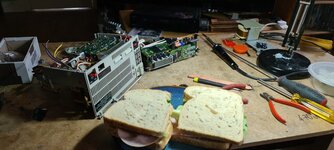
Pioneer ck-7. No power.

rivetmaster

Member (SA)
I don't usually take on boomboxes with electrical problems, but I'm in love with this Pioneer ck-7 and I wanted to do my best to fix it.
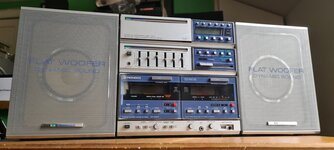
20260223_111341.jpg

I have the service manual for the amplifier.
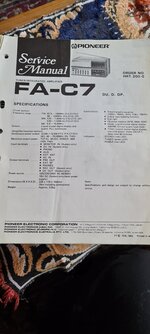
20260223_110736.jpg

After some disassembly I had the casing off and started checking for power across the switches etc. The fuses are good.
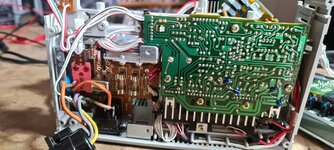
20260218_110036.jpg


So I found no power from the transformer. The AC in should be 17v across these terminals.
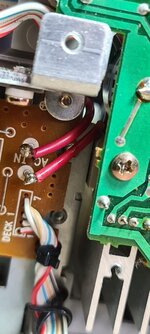
20260218_113700.jpg

Without checking anything else I set about removing the transformer. It was OL on the primary coils. I ordered a replacement from ebay.
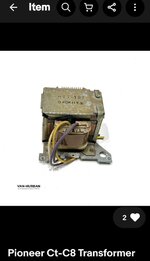
Screenshot_20260223_112732_eBay~2.jpg

Break time.

20260218_125641.jpg

Now it's all reassembled there is 16.9v across the AC in terminals, BUT NOTHING ELSE.

No life from the amp.

Please can you let me know what might be the next thing to check for.

Thanks guys
 

Tinman

Member (SA)
I'll ask it, are you sure the fuses are good?
I don't see + or - so I assume there isn't a polarity problem.
Any cold/cracked solder joints in that area?
With the SM, you should be able to trace from where the voltage comes in until it drops off.
You might need to get to the back side of that board and start looking and checking things out.
I'm confused with the 17v AC.
The SM is showing system power as being 15v DC on the cover.
 

rivetmaster

Member (SA)
I'll ask it, are you sure the fuses are good?
I don't see + or - so I assume there isn't a polarity problem.
Any cold/cracked solder joints in that area?
With the SM, you should be able to trace from where the voltage comes in until it drops off.
You might need to get to the back side of that board and start looking and checking things out.
I'm confused with the 17v AC.
The SM is showing system power as being 15v DC on the cover.
I'll definitely check the fuses again. The manual says 16.5 v ac from the transformer and 15v dc from the battery side. I'll get a picture of the schematic. I won't get chance to play with it until the weekend
 

thinkchronicity

Member (SA)
The 16.5v output from the transformer is about right. You'll lose a bit over the bridge rectifer and then the smoothing capacitors, bringing it down to 15v dc roughly.
You want to diode check all 4 diodes on the bridge rectifier out of circuit. You'll want to check the output caps too for shorts. Probably worth replacing as future insurance anyway.
 
  • Like
Reactions: rivetmaster

Tinman

Member (SA)
The 16.5v output from the transformer is about right. You'll lose a bit over the bridge rectifer and then the smoothing capacitors, bringing it down to 15v dc roughly.
You want to diode check all 4 diodes on the bridge rectifier out of circuit. You'll want to check the output caps too for shorts. Probably worth replacing as future insurance anyway.
Ok, 17v AC ------> rectifier ------> 15v DC.
 
  • Like
Reactions: rivetmaster

Superduper

Moderator
Staff member
The main unit does not have a battery supply. That figure is when the unit is powered from the deck, which only has 15V out so while the control unit is dual power capable, it's specs (and voltages) will differ when powered from the deck.
I'll definitely check the fuses again. The manual says 16.5 v ac from the transformer and 15v dc from the battery side. I'll get a picture of the schematic. I won't get chance to play with it until the weekend

The 16.5v output from the transformer is about right. You'll lose a bit over the bridge rectifer and then the smoothing capacitors, bringing it down to 15v dc roughly.
You want to diode check all 4 diodes on the bridge rectifier out of circuit. You'll want to check the output caps too for shorts. Probably worth replacing as future insurance anyway.

The power does not actually traverse all 4 diodes, the source and ground signals only travel through 1 diode each, the other 2 diodes are for blocking. So yes, the power does traverse through 2 diodes so there is some voltage drop associated with that, but that power signal has too much ripple to be useful at this point, so it is smoothed out and stiffened by the filter capacitors, which will boost the voltage up. So in practice, you will see a significant voltage boost, not drop when the power is filtered into usable DC. In fact, the schematic shows this voltage will be boosted to 21V.

The service manual shows voltage readings in the schematic. Just print out the schematic, highlight the voltage test points in yellow, and go about testing. When you come across a significant voltage discrepency, note it with a red tick. When you've completed your testing, that marked up schematic will be a wealth of information that'll identify the source of the problem.
 

thinkchronicity

Member (SA)
Yep sorry i screwed up there! Caps raise the dc (1.4x the rms ac of 15v) to about the peak ac level from the transformer. My excuse is too much hippy tree hugging lately.
 
  • Haha
Reactions: caution