

How to get inside a TDK boombox!
- Thread starter blu_fuz
- Start date
You are using an out of date browser. It may not display this or other websites correctly.
You should upgrade or use an alternative browser.
You should upgrade or use an alternative browser.

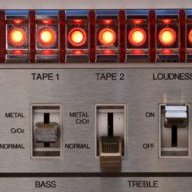


Anyone find a replacement power switch + pot for this? Finding various B503 D type switches that would work for volume but would have to bridge the power connector so its always on unless unplugged.
Last edited:
Regarding my 3-speaker issue: I bought this unit second-hand, so I have no idea what its brand-new condition should be.
The problems are as follows:
If it can be confirmed that the problem lies with the volume potentiometer, I plan to try replacing it. But I haven't removed the volume knob yet, so I don't know the exact model of the 3-speaker's volume potentiometer, nor whether I can find a potentiometer with a built-in switch. So far, I've seen in this thread that the 2-speaker model uses a B503 potentiometer, but I've tried searching and haven't found this model with a switch.
Additionally, I found the teardown photos provided by blu_fuz in this post extremely helpful, and I'm very grateful for that. I had an idea: since a full teardown is quite troublesome, and the Boombox has a large inner cavity that appears mostly empty with few obstructions on the upper left side, if I only need to replace the volume potentiometer, could I just remove the left speaker, reach into the Boombox's inner cavity through the speaker mounting hole, use a screwdriver to remove the PCB board screws, and take the volume potentiometer and PCB board out through the speaker opening? This would save a lot of effort. As for not being able to see the screws clearly, I can insert a camera with a light into the inner cavity, connect it to a monitor for a live feed, and perform the screw removal that way.
The problems are as follows:
- When the device is running and playing audio via USB or radio, even if the volume knob is turned to the minimum position, the sound is still very loud — louder than a person speaking at a normal volume. If you turn the volume knob slightly higher, the sound becomes extremely loud, to the point that it feels unbearable for the ears, so I never dared to turn it up further.
- When I play audio through the line input, the sound can be fully muted when the volume knob is at the minimum position. As I turn the knob up, the volume increases gradually. However, once the knob is rotated to roughly a quarter of its total travel, further turning of the volume adjustment knob no longer makes the volume any louder.
If it can be confirmed that the problem lies with the volume potentiometer, I plan to try replacing it. But I haven't removed the volume knob yet, so I don't know the exact model of the 3-speaker's volume potentiometer, nor whether I can find a potentiometer with a built-in switch. So far, I've seen in this thread that the 2-speaker model uses a B503 potentiometer, but I've tried searching and haven't found this model with a switch.
Additionally, I found the teardown photos provided by blu_fuz in this post extremely helpful, and I'm very grateful for that. I had an idea: since a full teardown is quite troublesome, and the Boombox has a large inner cavity that appears mostly empty with few obstructions on the upper left side, if I only need to replace the volume potentiometer, could I just remove the left speaker, reach into the Boombox's inner cavity through the speaker mounting hole, use a screwdriver to remove the PCB board screws, and take the volume potentiometer and PCB board out through the speaker opening? This would save a lot of effort. As for not being able to see the screws clearly, I can insert a camera with a light into the inner cavity, connect it to a monitor for a live feed, and perform the screw removal that way.

I have a 3 speaker also.
Funnily I have the exact same issue as you on the USB / Raido input. I have not tested line in yet. In my earlier post I found a B503 potentiometer, but alas, without a switch. If you gently pull off the volume knob, you can see its also a B503 on the 3 speaker too.
There are incorrect 50k ohm pots with switches that exist, but the shaft only comes in flower shape, and they lack the metal prongs to solder into the board itself to account for rotational torque.
I currently see the best route for repair (if it is the pot) as relacing it with a non-switch B503, hardwiring the power ON by bridging the pins, and then using a wall switch / unplugging the device to power it off from the socket instead.
Funnily I have the exact same issue as you on the USB / Raido input. I have not tested line in yet. In my earlier post I found a B503 potentiometer, but alas, without a switch. If you gently pull off the volume knob, you can see its also a B503 on the 3 speaker too.
There are incorrect 50k ohm pots with switches that exist, but the shaft only comes in flower shape, and they lack the metal prongs to solder into the board itself to account for rotational torque.
I currently see the best route for repair (if it is the pot) as relacing it with a non-switch B503, hardwiring the power ON by bridging the pins, and then using a wall switch / unplugging the device to power it off from the socket instead.
Have you replaced the volume potentiometer?What is the effect? Has the fault disappeared?I have a 3 speaker also.
Funnily I have the exact same issue as you on the USB / Raido input. I have not tested line in yet. In my earlier post I found a B503 potentiometer, but alas, without a switch. If you gently pull off the volume knob, you can see its also a B503 on the 3 speaker too.
There are incorrect 50k ohm pots with switches that exist, but the shaft only comes in flower shape, and they lack the metal prongs to solder into the board itself to account for rotational torque.
I currently see the best route for repair (if it is the pot) as relacing it with a non-switch B503, hardwiring the power ON by bridging the pins, and then using a wall switch / unplugging the device to power it off from the socket instead.
When you took it apart and checked, how many pins did the original potentiometer have? Is it 8 pins?
Have other people replaced the volume potentiometer? Did the fault disappear after replacement?
I hope to find a compatible volume potentiometer, so that it can still maintain its original switches and tuning functions.
I really love this speaker, and I've been obsessed with it lately.
Last edited:
Thank you very much for your reply and guidance.You would be better off hacking the circuit, adding a separate on/off latching switch and a working volume POT.
I want to keep the device completely original by using an integrated volume potentiometer with a switch, so that it can still look exactly as it did back then.
Is this volume potentiometer fixed to the device through the PCB board, or is it only secured to the device by the nut and the shaft fitting? If it is the latter case, I wanna find another type of volume potentiometer with a switch and solder it to the PCB board with wires. But I still need to consider whether the axial length of the potentiometer will obstruct the installation of the PCB board. If you or other technical experts have any guidance, I sincerely ask you to let me know.
I haven't tried the sound performance of the TDK 2-Speaker yet. I'd like to ask those who own both the 2-Speaker (TP6802) and the 3-Speaker (TP6803):
Compared between these two speakers, is the 2-Speaker worth owning at the same time? In what aspects does its sound quality and audio effect outperform the 3-Speaker?
If you have both of these two speakers, which one did you use more often?
Compared between these two speakers, is the 2-Speaker worth owning at the same time? In what aspects does its sound quality and audio effect outperform the 3-Speaker?
If you have both of these two speakers, which one did you use more often?
