


FM Radio Band Pre-War
- Thread starter MarioMania
- Start date
You are using an out of date browser. It may not display this or other websites correctly.
You should upgrade or use an alternative browser.
You should upgrade or use an alternative browser.
- Status
- Not open for further replies.

devol-toni
Member (SA)


redbenjoe
I Am Legend
Fatdog said:Oh, wow! I never knew that. I bet old man Ira would know.
i am way back in PRE-FM
---from the AM only days ........
one great AM radio feature was/is --that at 50,000 broadcast watts --
100-200 miles reception was a cinch

MasterBlaster84
Boomus Fidelis
Fatdog said:What WAS the old FM radio band?Did it not always go to 108 MHz?
I'm with ya Bobby, never heard about an old FM band only the AM band that pre-dated FM.


MasterBlaster84
Boomus Fidelis
71spud said:This is about the time someone brings up AM Stereo....
oops!
 How about Dolby FM?
71spud
Member (SA)
For more heavy reading.... http://en.wikipedia.org/wiki/FM_broadcast_band
ITU Region II Bandplan and Channel Numbering
The original bandplan in North America used 42–50 MHz, but this was changed in 1945. In Canada and the United States there are 101 channels, numbered from 200 (87.9 MHz) to 300 (107.9 MHz) in increments of 200 kHz. 87.9 MHz, while technically part of TV channel 6 (82.0–88.0 MHz), is used by two class-D stations in the United States. Portable radio tuners often tune down to 87.5, so the same equipment can be marketed worldwide. Automobiles are unlikely to go overseas, but usually tune down to 87.7, so that TV channel 6 audio on 87.75 MHz can be received (although at a somewhat lower volume).
In the United States, the twenty channels with center frequencies of 88.1–91.9 MHz (channels 201–220) constitute the reserved band, exclusively for non-commercial and educational (NCE) stations. The other channels (92.1–107.9 MHz, and 87.9 MHz, where used) may be used by both commercial and non-commercial stations. (Note that Canada and Mexico do not observe this reservation.)
Originally, the United States FCC devised a bandplan in which stations would be assigned at intervals of 4 channels (800 kHz separation) for any one geographic area. Thus, in one area, stations might be at 88.1, 88.9, 89.7, etc., while in an adjacent area, stations might be at 88.3, 89.1, 89.9, 90.7 etc. Certain frequencies were designated for Class A only (see FM broadcasting), which had a limit of 3 kW ERP and an antenna height limit for the center of radiation of 300 feet (91.4 m) height above average terrain (HAAT). These frequencies were 92.1, 92.7, 93.5, 94.3, 95.3, 95.9, 96.7, 97.7, 98.3, 99.3, 100.1, 100.9, 101.7, 102.3, 103.1, 103.9, 104.9, 105.5, 106.3 and 107.1. On other frequencies, a station could be Class B (50 kW, 500 feet) or Class C (100 kW, 2000 feet), depending on which zone it was in.
In the late 1980s the FCC switched to a bandplan based on a distance separation table using currently operating stations, and subdivided the class table to create extra classes and change antenna height limits to meters. Class A power was doubled to 6 kW, and the frequency restrictions noted above were removed. Basically, as of late 2004, a station can be "squeezed in" anywhere as long as the location and class conform to the rules in the FCC separation table.[2] The rules for second-adjacent-channel spacing do not apply for stations licensed prior to 1964.

Boom Shaka Laka
Requiem Æternam
Try this:TW5 said:That happened to channel 1 on the TV ?
http://www.discovery.com/area/skinnyon/skinnyon971031/skinnyon.html
Ghettoboom767
Member (SA)
I remember back on the 60's when am was basically the only thing unless you had one of those big consoles ans even then FM was only classical stations!! 
If you had a FM radio back then well-nobody cared because none of us yougsters would dare listen to classical music-only for the folks.
I do have a Pioneer SX-V90 that does have hook up for AM stereo! I've never used it or even know how to!
BUT- I do have an Alpine reference deck that has Dolby FM and it's incredible! Not all stations have this feature but when they do like Power 96 out of Ft.lauderdale & Dance 93.1 and rock 105 yes-it's so clear and brilliant!! I love Dolby FM!


Love radios!
GB.
If you had a FM radio back then well-nobody cared because none of us yougsters would dare listen to classical music-only for the folks.
I do have a Pioneer SX-V90 that does have hook up for AM stereo! I've never used it or even know how to!
BUT- I do have an Alpine reference deck that has Dolby FM and it's incredible! Not all stations have this feature but when they do like Power 96 out of Ft.lauderdale & Dance 93.1 and rock 105 yes-it's so clear and brilliant!! I love Dolby FM!
Love radios!
GB.
MasterBlaster84
Boomus Fidelis
Ghettoboom767 said:BUT- I do have an Alpine reference deck that has Dolby FM and it's incredible! Not all stations have this feature but when they do like Power 96 out of Ft.lauderdale & Dance 93.1 and rock 105 yes-it's so clear and brilliant!! I love Dolby FM!
Love radios!
GB.
I thought Dolby FM was dead or at least that's what I've read.
Ghettoboom767
Member (SA)
MasterBlaster84 said:Ghettoboom767 said:BUT- I do have an Alpine reference deck that has Dolby FM and it's incredible! Not all stations have this feature but when they do like Power 96 out of Ft.lauderdale & Dance 93.1 and rock 105 yes-it's so clear and brilliant!! I love Dolby FM!
Love radios!
GB.
I thought Dolby FM was dead or at least that's what I've read.
Hi Don! Even if it is-on some stations when I hit the button it attenuates all the high frequencies-it's brilliant!!
This deck even has DBX!! Now that's a whole ohter story!
Never had a DBX encoder for recording so I never encoded any tapes but I'm thinking about getting oen someday!
I love Alpine's I have a 7347 reference deck! it's insane -singnal to noise ratio with dolby C is about 80db and 86db with DBX! That's almost CD quality!
I've never heard another car stereo with cassette that's this clear.
It was the original equipment in the Lamborghini Countach S!
Yeah-if anyone has more info on Dolby FM post it!
Have a great weekend-Jeff.
71spud
Member (SA)
MasterBlaster84 said:Ghettoboom767 said:BUT- I do have an Alpine reference deck that has Dolby FM and it's incredible! Not all stations have this feature but when they do like Power 96 out of Ft.lauderdale & Dance 93.1 and rock 105 yes-it's so clear and brilliant!! I love Dolby FM!
Love radios!
GB.
I thought Dolby FM was dead or at least that's what I've read.
I am pretty sure it IS dead... although the Dolby button might still have some effect on the sound, like it does with tapes, even if the broadcast is not Dolby.
Hey how about this... did you know there was at one point "Quadraphonic FM"??? It was invented in 1969 and the first station to broadcast in Quadraphonic FM was WQIB in Ann Arbor Michigan?
MasterBlaster84
Boomus Fidelis
Ghettoboom767 said:[
Hi Don! Even if it is-on some stations when I hit the button it attenuates all the high frequencies-it's brilliant!!
This deck even has DBX!! Now that's a whole ohter story!
Never had a DBX encoder for recording so I never encoded any tapes but I'm thinking about getting oen someday!
Ah I get ya Jeff.
I have an old Sony STR-680SD receiver with Dolby FM that I've yet to hook up, looks like I have something to play with when I get a chance.
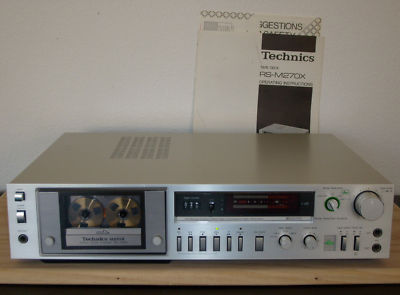
For a DBX recording you should look at picking up a Technics RS-M270X tape deck, they have a DBX option for record and playback. It's a pretty good deck with direct drive, cool looks, Flourescent meeters and a large and heavy case. I picked mine up at Goodwill but they can be found on eBay for very little $$$. Here's a pic off the internet, it's not mine.
Sorry for getting a little of topic guys.
Ghettoboom767
Member (SA)
71spud said:MasterBlaster84 said:Ghettoboom767 said:BUT- I do have an Alpine reference deck that has Dolby FM and it's incredible! Not all stations have this feature but when they do like Power 96 out of Ft.lauderdale & Dance 93.1 and rock 105 yes-it's so clear and brilliant!! I love Dolby FM!
Love radios!
GB.
I thought Dolby FM was dead or at least that's what I've read.
I am pretty sure it IS dead... although the Dolby button might still have some effect on the sound, like it does with tapes, even if the broadcast is not Dolby.
Hey how about this... did you know there was at one point "Quadraphonic FM"??? It was invented in 1969 and the first station to broadcast in Quadraphonic FM was WQIB in Ann Arbor Michigan?
Hi Spud! That's crazy! I never knew about Quad FM!! I did have a friend in the 70's with a Quadraphonic Pioneer stereo! it was cool! had a joystick for going from 1 corner to another.sounded great & the cool blue dial light to.
Don-I'll have to check out one of those DBX decks!! That would be cool to encode some tapes for the Alpine.
BTW-Spud-just got off a long talk with Scott! Hoping to hook up the first week of March on my way back to Tn.
Thinking about boomin some jvc's or what not! Sorry about the off-topic bust it is mostly about radios!
Have a great weekend guys-hopefully a video of the Frankestein JVC 838JW this weekend!!-Jeff.
- Status
- Not open for further replies.