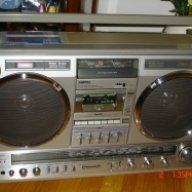
For those of you hobbyists and tinkerers that frequently restore boomboxes, you will often come across a situation where you will need lubricants for:
Although many service manuals will specify particular lubricants they prefer you to use, the honest truth is that finding those are near impossible, or if you can actually find 40 year old OEM lubricants, they probably aren't lubricants anymore.
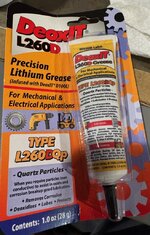
Did you know... that Caig Deoxit offers a full line of grease? Here are 2 examples. One has the suffix NP. That means it has no particles in it. That one in the tub has a clear pinkish lithium grease supposedly in a synthetic base. It's infused with deoxit too. The other one in the example has the QP suffix. That means it has quartz particles in it, which supposedly on some surfaces such as switches and relay contacts, can prevent the formation of new oxidation by means of the "particles" scrubbing off any new that forms. I wouldn't use this on switches with tiny feelers that have little pressure. But on strong switches or slide types of switches where a thin layer of grease should not interfere with electrical connectivity, the presence of these microscopic quartz particles might be just the ticket. The types of switches I'm thinking about are like the slide switches on the rear of the M90 that switches phono/line-in. As you all know, this switch is notorious for oxidation.
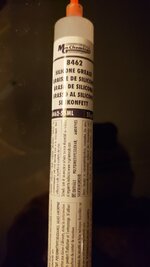
Besides the 2 examples here, Caig Deoxit has so many other ones that you could go crazy if you want. But you can probably get by with just one. Remember never to use automotive grade grease because those are most likely petroleum based which will degrade rubber and maybe plastics over time. I also like to use silicone grease but dislike the consistency which is akin to jello. When you try to spread it, it can get clumpy like cottage cheese, so these Deoxit products are a great option.


- Rebuilding sliders
- Lubricating cassette doors
- Rebuilding switches
- Lubricating cassette levers and slides and pivots
Although many service manuals will specify particular lubricants they prefer you to use, the honest truth is that finding those are near impossible, or if you can actually find 40 year old OEM lubricants, they probably aren't lubricants anymore.
Did you know... that Caig Deoxit offers a full line of grease? Here are 2 examples. One has the suffix NP. That means it has no particles in it. That one in the tub has a clear pinkish lithium grease supposedly in a synthetic base. It's infused with deoxit too. The other one in the example has the QP suffix. That means it has quartz particles in it, which supposedly on some surfaces such as switches and relay contacts, can prevent the formation of new oxidation by means of the "particles" scrubbing off any new that forms. I wouldn't use this on switches with tiny feelers that have little pressure. But on strong switches or slide types of switches where a thin layer of grease should not interfere with electrical connectivity, the presence of these microscopic quartz particles might be just the ticket. The types of switches I'm thinking about are like the slide switches on the rear of the M90 that switches phono/line-in. As you all know, this switch is notorious for oxidation.
Besides the 2 examples here, Caig Deoxit has so many other ones that you could go crazy if you want. But you can probably get by with just one. Remember never to use automotive grade grease because those are most likely petroleum based which will degrade rubber and maybe plastics over time. I also like to use silicone grease but dislike the consistency which is akin to jello. When you try to spread it, it can get clumpy like cottage cheese, so these Deoxit products are a great option.