Crack in Conion shelf

Jack_Dowdy

Member (SA)
IMG_5245.jpeg
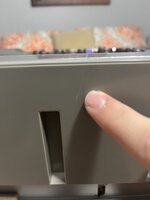
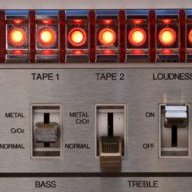
Hey guys, I just found a small crack in the Conion tape shelf. I’m not too surprised nor pissed off but I was curious if anyone had any good advice on how to fix a tiny crack on 40 year old plastic. I doubt it’s a hard fix but I don’t want to make the crack bigger whenever I shoulder surf the Conion. See yall later.
 

Fatdog

Well-Known Member
Staff member
It’s a clean crack, I can move both sides of the shelf near the crack
Dang. If you can do that, yeah it's definitely a crack. Get with @Superduper . He has knowledge of cyanoacrylate glue and could probably suggest a good, thin, plastic weld-type glue for you.
 

Superduper

Moderator
Staff member
Weld On makes many plastic adhesives and glues and you can buy them from Tap Plastics (go there if you have one in your area). Or you can go buy through their website. Their products are a form of solvent that is thinner than water, and does not "glue" things together. Rather they flow via capillary action into the cracks and temporarily "melts" the plastic chemically, and when the solvent evaporates, you will be left with the product literally fused back together. There are no fillers so it has to be a clean snap like that. If you have gaps, you'll have to use an epoxy type of adhesive which will look like putty slathered on top. Almost all classic boomboxes use plastics that will work with these adhesives, even though they might say for PVC, ABS, Vinyl, etc. To be sure, you can try a tiny drop in an obscure location of the boombox, maybe interior. If it affects it and turns it gooey, it will work. If the drop stays on top like a rain drop, and the plastic does nothing, it is incompatible with that type of plastic. DO NOT use cyanoacrylate or any type of superglue if you want to use the solvent type of adhesive. superglue will contaminate the surface and won't allow the solvent to do it's job unless you scrape it off, but then you'll be missing chunks or bits that will result in a less than ideal bond. One caveat... it's not good to use on the front cabinet shells where the break traverses chrome, or lettering. It is a solvent and as it's so thin, it is hard to control, and it WILL remove lettering, distort clear acrylic, and damage decals, and applied chrome (not true metal chrome but the kind that is like paint. In fact, the surface tension is totally lacking on this product so you literally can't deposit a drop if you want. A hyperdermic needle inverted won't drip, it will shooot out in a narrow stream with no pressure.

 
  • Like
Reactions: Jack_Dowdy

Jack_Dowdy

Member (SA)
Weld On makes many plastic adhesives and glues and you can buy them from Tap Plastics (go there if you have one in your area). Or you can go buy through their website. Their products are a form of solvent that is thinner than water, and does not "glue" things together. Rather they flow via capillary action into the cracks and temporarily "melts" the plastic chemically, and when the solvent evaporates, you will be left with the product literally fused back together. There are no fillers so it has to be a clean snap like that. If you have gaps, you'll have to use an epoxy type of adhesive which will look like putty slathered on top. Almost all classic boomboxes use plastics that will work with these adhesives, even though they might say for PVC, ABS, Vinyl, etc. To be sure, you can try a tiny drop in an obscure location of the boombox, maybe interior. If it affects it and turns it gooey, it will work. If the drop stays on top like a rain drop, and the plastic does nothing, it is incompatible with that type of plastic. DO NOT use cyanoacrylate or any type of superglue if you want to use the solvent type of adhesive. superglue will contaminate the surface and won't allow the solvent to do it's job unless you scrape it off, but then you'll be missing chunks or bits that will result in a less than ideal bond. One caveat... it's not good to use on the front cabinet shells where the break traverses chrome, or lettering. It is a solvent and as it's so thin, it is hard to control, and it WILL remove lettering, distort clear acrylic, and damage decals, and applied chrome (not true metal chrome but the kind that is like paint. In fact, the surface tension is totally lacking on this product so you literally can't deposit a drop if you want. A hyperdermic needle inverted won't drip, it will shooot out in a narrow stream with no pressure.
This is the exact kind of response I needed, thanks a bunch
 

caution

Member (SA)
I don’t want to make the crack bigger whenever I shoulder surf the Conion

If you really want to do this (and I don't blame you, it looks awesome!) please seriously consider adding a piece stiff piece of material, perhaps with some foam also to cushion your shoulder. It doesn't have to be permanent, just for when you shoulder surf it. Would be tragic if you cracked it again! That drawer is thin AF and wasn't designed to take the full weight of the box. Worst case, I've 3d-modeled it and can be replaced with a much tougher plastic. Ain't modern technology great?! :breakdance:
 
  • Like
Reactions: Jack_Dowdy

Jack_Dowdy

Member (SA)
If you really want to do this (and I don't blame you, it looks awesome!) please seriously consider adding a piece stiff piece of material, perhaps with some foam also to cushion your shoulder. It doesn't have to be permanent, just for when you shoulder surf it. Would be tragic if you cracked it again! That drawer is thin AF and wasn't designed to take the full weight of the box. Worst case, I've 3d-modeled it and can be replaced with a much tougher plastic. Ain't modern technology great?! :breakdance:
Are you suggesting I put cushioning in the shelf?
 

caution

Member (SA)
Not *in* it but underneath, between it and your shoulder - maybe cut out a thin piece of fiber board that will fit in the area inside the red rectangle

54977112814_de235907bd_b.jpg