

Panasonic Rx dt9
- Thread starter bigronnie
- Start date
You are using an out of date browser. It may not display this or other websites correctly.
You should upgrade or use an alternative browser.
You should upgrade or use an alternative browser.

You purchased a japanese domestic model. Very few people imports those because of the reduced FM bandwidth and weird 9khz tuning steps on AM. And there is no 1:1 equivalent form Japanese to non-japanese models, so your chances of finding that transformer and PCB is slim. Your best bet is to rehabilitate that PS and transformer. There's nothing really special about transformers, it just steps down AC to the power requirements of your boombox. Just get a new transformer that is suitable in terms of size and voltage and mounting style, and on the PCB, just replace any electrolytic capacitors (they abhor over voltage conditions) and replace the bridge rectifier or diodes. Then you'll have a regionally correct AC capable boombox. Alternatively, you might have better luck trying to source a similar regional variant. Maybe the RX-DT75? Just be mindful that if you haven't yet checked to see if the boombox itself is damaged, you might discover after going through a lot of trouble that the PS is just the beginning of your problems.
You purchased a japanese domestic model. Very few people imports those because of the reduced FM bandwidth and weird 9khz tuning steps on AM. And there is no 1:1 equivalent form Japanese to non-japanese models, so your chances of finding that transformer and PCB is slim. Your best bet is to rehabilitate that PS and transformer. There's nothing really special about transformers, it just steps down AC to the power requirements of your boombox. Just get a new transformer that is suitable in terms of size and voltage and mounting style, and on the PCB, just replace any electrolytic capacitors (they abhor over voltage conditions) and replace the bridge rectifier or diodes. Then you'll have a regionally correct AC capable boombox. Alternatively, you might have better luck trying to source a similar regional variant. Maybe the RX-DT75? Just be mindful that if you haven't yet checked to see if the boombox itself is damaged, you might discover after going through a lot of trouble that the PS is just the beginning of your problems.
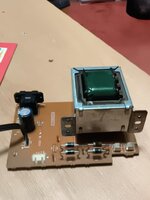
Hey appreciate your response, here it is, other than the transformer, which bits shown need replacing, are they all 100 v relavent
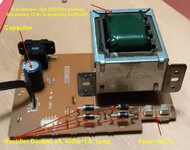
This should retrofit your PS so it can work safely in your area without any adapters. It appears this transformer is a PCB mounted design. They are harder to find but standard Triad F6-12 or Hammond 187D10 might work with some modification on 120v locations, and 230/240 volt versions of those similar ones should be available. You can search the catalogs at Farnell or Newark or Mouser.com or Digikey.com and try to find one that bests matches the size and layout. The actual physical size and wireout specifications can be found by looking at the product datasheets. Remember that the transformers I mentioned above are 120v versions. You should look for similar ones with 230 or 240v primaries. If the new transformer has tabs instead of pins, and they match up with the circuitry on the pcb, you can connect them with paper clips bent and shaped. Paper clips has the thickness and rigidity to hold the transformer down but it's important to make sure they line up, if they do not, do not randomly assign the transformer leads to the nearest pcb through hole. The diodes are nothing special, just get general purpose rectifier diodes that are at least 400v, and it appears these are 1A diodes. The capacitor should be on the secondary side so a 25 or 35v capacitor with the same or higher uf capacity should be fine. I'm not sure if a fuse was originally installed there or not, but if there was and it was blown, get the correct sized one. If unknown, you should check the traces underneath to see if it is protecting the primary or secondary side, it's most likely the secondary side. If it is protecting the primary size, the fuse should only be about 1/4a to 1/2a max. But given that if that was a primary side fuse, those tabs would be high voltage so that is unlikely as the designers would not want to create an unprotected (insulated) hazard on the pcb.
Last edited:
This is awesome thanks a lot, my stereo takes 10 x Lr20 batteries totaling 15 v, does the transformer need to give an output of the same value 15 v ?View attachment 62002
This should retrofit your PS so it can work safely in your area without any adapters. It appears this transformer is a PCB mounted design. They are harder to find but standard Triad F6-12 or Hammond 187D10 might work with some modification on 120v locations, and 230/240 volt versions of those similar ones should be available. You can search the catalogs at Farnell or Newark or Mouser.com or Digikey.com and try to find one that bests matches the size and layout. The actual physical size and wireout specifications can be found by looking at the product datasheets. Remember that the transformers I mentioned above are 120v versions. You should look for similar ones with 230 or 240v primaries. If the new transformer has tabs instead of pins, and they match up with the circuitry on the pcb, you can connect them with paper clips bent and shaped. Paper clips has the thickness and rigidity to hold the transformer down but it's important to make sure they line up, if they do not, do not randomly assign the transformer leads to the nearest pcb through hole. The diodes are nothing special, just get general purpose rectifier diodes that are at least 400v, and it appears these are 1A diodes. The capacitor should be on the secondary side so a 25 or 35v capacitor with the same or higher uf capacity should be fine. I'm not sure if a fuse was originally installed there or not, but if there was and it was blown, get the correct sized one. If unknown, you should check the traces underneath to see if it is protecting the primary or secondary side, it's most likely the secondary side. If it is protecting the primary size, the fuse should only be about 1/4a to 1/2a max. But given that if that was a primary side fuse, those tabs would be high voltage so that is unlikely as the designers would not want to create an unprotected (insulated) hazard on the pcb.
A 12.6vac transformer outputs an "average" of 12.6v AC at the secondaries before rectification. After rectification and capacitor filtered, the peak DCV is going to be around 18 or 19VDC. If you jumped up to the next sized transformer (14.4v), you will get over 20VDC peak. Generally speaking, with a full bridge rectifier and a capacitor filtered output, you are going to get approximately 1.4x the AC secondary output in DC.
By the way, most boomboxes use unregulated power supplies, so that means that the peak voltage will indeed be higher than the normal DC battery equivalent. On use and with a load applied, the voltage will begin to droop. You would expect that the "average" voltage will be approximately your battery voltage. In practice, I have noticed most 15v boomboxes will actually measure about 20-21 volts at the DC rails. This is likely normal for most 15 volt boxes. If you tailor your PS so it outputs 15vdc at the rails when powered with AC, upon a load, the voltage will drop several volts and will probably distort or clip at maximum volume.
By the way, most boomboxes use unregulated power supplies, so that means that the peak voltage will indeed be higher than the normal DC battery equivalent. On use and with a load applied, the voltage will begin to droop. You would expect that the "average" voltage will be approximately your battery voltage. In practice, I have noticed most 15v boomboxes will actually measure about 20-21 volts at the DC rails. This is likely normal for most 15 volt boxes. If you tailor your PS so it outputs 15vdc at the rails when powered with AC, upon a load, the voltage will drop several volts and will probably distort or clip at maximum volume.

Yeah I pulled the fuse as it was blown, I've ordered some batteries to tryThe fuse is missing in the picture. I think one of the diodes is burnt out?
Does the Boombox work on batteries? If so, that's a good result.
Forgive my persistence, this isn't my forte, can this be changed to a 240v? if so could you list the relevent specs of diodes and capacitor for this change. As well as the transformer spec needed so I can order the right one please, I'm not familiar with the jargon used in this field.A 12.6vac transformer outputs an "average" of 12.6v AC at the secondaries before rectification. After rectification and capacitor filtered, the peak DCV is going to be around 18 or 19VDC. If you jumped up to the next sized transformer (14.4v), you will get over 20VDC peak. Generally speaking, with a full bridge rectifier and a capacitor filtered output, you are going to get approximately 1.4x the AC secondary output in DC.
By the way, most boomboxes use unregulated power supplies, so that means that the peak voltage will indeed be higher than the normal DC battery equivalent. On use and with a load applied, the voltage will begin to droop. You would expect that the "average" voltage will be approximately your battery voltage. In practice, I have noticed most 15v boomboxes will actually measure about 20-21 volts at the DC rails. This is likely normal for most 15 volt boxes. If you tailor your PS so it outputs 15vdc at the rails when powered with AC, upon a load, the voltage will drop several volts and will probably distort or clip at maximum volume.
Thank you for your patience. Ron.